
On this page
- 3D Architectural Rendering Cost at a Glance (2026)
- 3D Rendering Price List 2026: What Studios Actually Publish
- How Much Does an Interior Rendering Cost?
- How Much Does a 3D Exterior Rendering Cost?
- Six Factors That Move a Rendering Quote
- What Does One Approved Image Really Cost?
- What Does Rendering It Yourself Really Cost?
- How Does AI Rendering Change the Cost Math?
- Which Option Fits Your Project?
- 3D Architectural Rendering Cost: The Bottom Line
3D architectural rendering cost in 2026 runs from $249 for a budget interior still to $4,000 for a premium exterior, with most professional stills landing between $500 and $2,500; 3D architectural visualization cost is the same market under a different name, and the same price lists apply. This guide is written by the team behind Visualizee, an AI rendering tool that turns a sketch, a SketchUp or Revit screenshot or a photo into a photorealistic render in about 30 to 60 seconds while keeping the geometry. Below are ten studios' published 2026 price lists (US and UK), what interior and exterior renders cost separately, the fees that never appear in the headline number, and a worksheet for the figure that actually matters: the cost of one approved image.
Quick answer: A professional still costs $500-$2,500 at most rendering studios in 2026. Interiors start at $249-$600, exteriors at $400-$750, aerials at $600-$1,200, and premium tiers reach $2,600 (interior), $4,000 (exterior) and $3,000+ (aerial). Animation runs $1,500-$12,000 per finished minute, premium studios $20,000+. Freelancers charge $25-$150 per hour. Rendering in-house means software, a $3,500-$5,000 workstation (our estimate) and an artist's salary. AI rendering starts at $15 per month and produces a Pro-quality render for about $0.27 on the Pro plan.
3D Architectural Rendering Cost at a Glance (2026)
Across the ten studios with public 2026 price lists we checked, a professional still lands between $500 and $2,500, and the spread below reflects studio tier, not haggling room. Budget means a fixed-price online studio, typical means a mid-market studio in North America, premium means a studio with a named portfolio and a bespoke process.
| Deliverable | Budget | Typical studio | Premium |
|---|---|---|---|
| Interior still | $249-$600 | $600-$1,500 | $1,400-$2,600 |
| Exterior still | $400-$750 | $750-$2,500 | $3,200-$4,000 |
| Aerial or streetscape | $600-$1,000 | $1,000-$2,500 | $3,000+ |
| Animation (per finished minute) | $1,500-$2,500 | $4,000-$12,000 | $20,000+ |
| 360 panorama or virtual tour | $200-$500 per view | $1,500-$2,500 per space | $1,600-$4,000+ per project |
| AI rendering (subscription) | Free start | $15-$35 per month | $80 per month |
The premium exterior ceiling is NoTriangle Studio's published $800-$4,000 exterior range (November 2025); Omega Render's list tops out at $3,200. Ranges compiled from price lists published or updated in 2025-2026 by Render3DQuick, ArchiCGI, 7CGI, Trim Render, Bella Virtual, Provisual, RealSpace3D, Omega Render, NoTriangle Studio and Cad Crowd, all checked on 14 September 2026. Rendering is one deliverable inside a wider pipeline; for how it sits next to modelling and presentation, see what architectural visualization covers.
3D Rendering Price List 2026: What Studios Actually Publish
Ten studios publish per-image prices, and seven of the eight North American studios list a residential interior at $249-$600 and an exterior at $399-$750; only Omega Render starts above $900. Studios rarely publish prices at all, which is exactly why the ones that do are worth reading closely. Prices are per image unless noted; UK studios quote in pounds.
| Studio (list date) | Interior | Exterior | Aerial | Animation |
|---|---|---|---|---|
| Render3DQuick, US (Mar 2026) | $249 | $499 | $799 | $2,500 per minute |
| ArchiCGI, US (Sep 2026) | from $300 (commercial from $400) | from $600 (commercial from $900) | from $1,200 | from $3,600 per project |
| 7CGI, US (Jun 2026) | $300 / $500 / $800 | $400 / $750 / $1,000 | from $600 | from $25 per second |
| Trim Render, US | $500 (4 views $1,600) | $700 (4 views $2,200) | $900 | $75 per second |
| Bella Virtual, N. America (Aug 2026) | $550 (commercial $700) | from $750 | $1,000 | quote |
| Provisual, US | $600 (commercial $850) | $550 / $770 / $990 | $990 | $110 per second |
| RealSpace3D, Canada (Apr 2026) | $600-$1,500 | $399 presentation / $799 marketing | $1,000-$3,000 | $4,000-$12,000 per minute |
| Omega Render, US (2026) | $1,400-$2,600 | $900-$3,200 | quote | $6,000-$12,000 per minute |
| TMD Studio, UK | £400-£500 / £550-£800 / £850+ | £350-£500 / £550-£800 / £850+ | £450-£550 / £600-£850 / £900+ | quote |
| CGIs Newcastle, UK (Jun 2026) | from about £400 + VAT | from about £450 + VAT | quote | 360 tour £1,200-£4,000 + VAT |
Three patterns stand out. First, the budget tier is real and fixed-price: Render3DQuick, ArchiCGI, 7CGI and Trim Render all sell a residential still for $249-$700 with the price on the page. Second, tiering is replacing discounting: RealSpace3D sells a $399 "presentation" render next to a $799 "marketing" render of the same scene, 7CGI and Provisual publish three complexity tiers, and TMD Studio splits every deliverable into lean, standard and signature, with revision rounds and turnaround rising by tier. Third, Europe is two markets: a Chaos CGconnect analysis of European pricing puts Western European studios at "€1,000+ per image by default" and Eastern European studios at $500-$2,000, with lows of €300 and $200 respectively (CGconnect, March 2025).
Freelancers price by the hour, not the image. Upwork's own rate page puts 3D rendering artists at a $30 per hour median (typical range $25-$40), US-based senior freelancers quote $50-$150 per hour (Render3DQuick, 2026), and Cad Crowd puts the marketplace range at $30-$150. An hourly rate tells you nothing until you know how many hours your scene needs; modelling from scratch can quietly double a quote. Fiverr gigs start around $35 per exterior render with extra angles of the same model at about $10 each. The price is real, and so is the quality lottery.
3D Rendering Prices in the UK (2026)
UK studios charge £350-£850+ per exterior still and £400-£850+ per interior, with fixed-price studios starting around £400-£450 plus VAT. TMD Studio publishes three tiers: lean (£350-£500 exterior, £400-£500 interior, one revision round, about four working days), standard (£550-£800, two rounds) and signature (£850+, up to three rounds, ten working days or more). CGIs Newcastle starts at about £450 plus VAT for an exterior and £400 plus VAT for an interior, with 360 tours at £1,200-£4,000 plus VAT (June 2026). Freelance CGI day rates "will typically range from £250 to £500 per day", with a small development priced at £1,000-£5,000 (iCreate). Converted at roughly $1.30 to the pound, the UK mid-market sits inside the same $500-$1,100 band as North America.

How Much Does an Interior Rendering Cost?
A residential interior rendering costs $249-$600 at budget and mid-market studios and $1,400-$2,600 at premium studios in 2026, and the single biggest price driver is furniture: whether the studio can use library models or has to build your pieces. Interiors are the cheapest still on most price lists because a room needs no site, no landscaping and no aerial context, but they are also the deliverable where scope creep hides.
What moves an interior quote, according to the studios' own pages:
- Custom furniture and fixtures. 7CGI itemises custom modelling at $30-$100 per element and adding people at $100-$200 per room, and states plainly that bespoke furniture and accessories "often require additional modeling and material development". NoTriangle lists custom furniture, night scenes and complex lighting as upcharges.
- Luxury and marketing styling. UK studio NVision quotes luxury interiors "starting at $2,800 and reaching beyond $9,000 per render" once the styling is campaign-grade (NVision Studios, 2025).
- Number of views of the same room. Trim Render's own card prices four interiors at $1,600 against $500 for one, a 20% saving per image; NVision puts the multi-view discount at 15-25% and ArchiCGI says volume discounts "can reach 40%" on large batches.
- Commercial versus residential. ArchiCGI and Bella both charge $100-$150 more per image for commercial interiors, because retail and hospitality scenes carry more custom elements.
The cheapest way to buy an interior render is therefore to order every view at once and to give the studio a furniture list it can source from libraries. The most expensive way is to change the sofa after round two.
How Much Does a 3D Exterior Rendering Cost?
An exterior still costs $400-$750 at fixed-price studios, $750-$2,500 mid-market and $3,200-$4,000 at premium studios; aerials add $200-$600 on top of the same studio's exterior price because the site, the neighbours and the landscaping all have to be modelled. On the price lists above, ArchiCGI prices an exterior from $600 and an aerial from $1,200, Provisual $550-$990 and $990, Bella $750 and $1,000, and Trim Render $700 and $900.
Two things push an exterior quote up faster than any other: context and light. A house on a white ground plane is the base price; a house with its street, planting, cars and neighbouring buildings is an aerial in all but name. Dusk and night views cost extra at most studios because they need interior lighting and a second lighting pass, which is why the dusk render is the image clients ask for last and pay for most. Both are jobs an AI renderer handles as a one-line prompt on an existing render, which matters for the worksheet further down.
Six Factors That Move a Rendering Quote
Six levers move a quote by $50 to $2,000: complexity, view count, revision rounds, deadline, resolution and post-production, and revision rounds are the one that blows budgets. Knowing them turns a quote from a mystery into a negotiation.
- Scene complexity. A minimalist bedroom and a glass-heavy atrium with custom furniture are different jobs; custom-modelled items add $30-$100 each at 7CGI and $25-$150 at NoTriangle.
- Number of views. Ordering 4+ images of the same scene earns a 15-30% per-image discount (RealSpace3D, April 2026); the model is already built.
- Revision rounds. Bella includes two rounds, Omega Render three, TMD one to three depending on tier, Trim Render "2 draft versions and 1 final". After that, expect $100-$400 per extra round at RealSpace3D and $50-$200 on Cad Crowd. Clients rarely stop at round three.
- Deadline. Rush delivery adds 25-50% at RealSpace3D and NVision and 20-50% at NoTriangle; Cad Crowd quotes 50-100% for 48-72 hour turnaround.
- Resolution. At Omega Render, 4K animation costs roughly double the Full HD price for the same footage.
- Post-production. People, atmosphere, landscaping and marketing polish are often quoted as a separate pass.
Turnaround follows the same logic. Render3DQuick quotes 3-4 days for a still, RealSpace3D 3-10 days, Bella 7-10 business days for interiors and 10-14 for exteriors, TMD "about 4 working days" on its lean tier and 10 or more on signature. Provisual quotes 15-30 days for animation and iCreate says a 3D flythrough "can take 4-6 weeks". If your client meeting is Thursday, turnaround is a cost.
What Does One Approved Image Really Cost?
One approved studio image costs about $2,000 on a $1,500 quote once a third revision round and four hours of your time are counted; one approved AI image costs about $25, almost all of it your time. The number to compare is never the quote but the cost of the image the client signs off: the quote plus the revision rounds you actually needed plus the hours you spent briefing, reviewing and fixing.
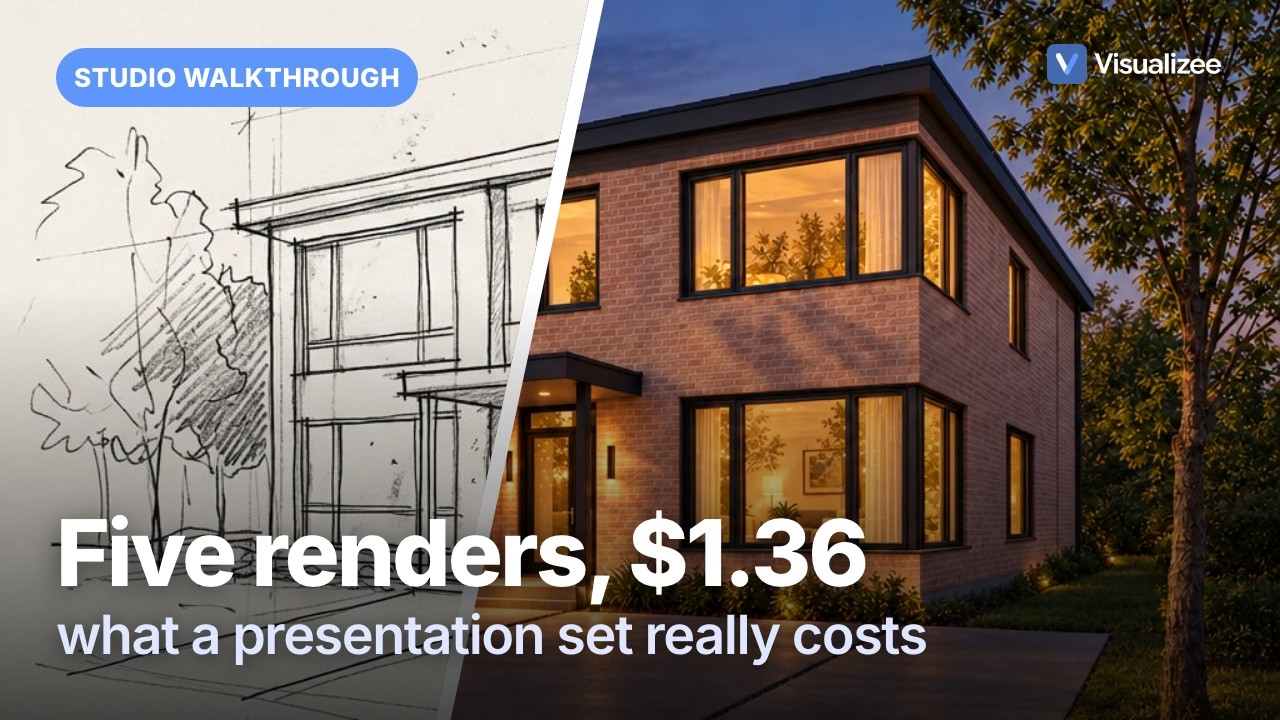
We measured the AI side rather than estimating it. In the recorded sketch-to-render walkthrough, one pen sketch became a Pro-quality render in 53 seconds, then took a facade material change (59 seconds) and a marked-region door colour change (65 seconds): three Pro renders, 3 minutes 32 seconds from sketch to approved door, with no retouching. The recorded presentation set went further on the same sketch: the day view, a brick option, the dusk view, a marked-region door revision and a winter mood image, five Pro renders in 6 minutes 27 seconds, about $1.36 on the Pro plan, with no retries. The worksheet takes its three attempts from those recordings and sets its time defaults deliberately higher than the recordings showed, 3 minutes per attempt plus 10 minutes of manual fixes, so the AI column is not flattered.
Worksheet
What does one approved image cost you?
Not the quote: the quote plus the revision rounds and the hours you spend briefing, reviewing and fixing. Change any number; defaults come from the price table above.
Studio or freelancer
AI rendering
Studio, per approved image
$2,069
$1,500 quote + $250 extra rounds + 4.3 h of your time
AI, per approved image
$25
3 x $0.27 per render + 0.3 h of your time
Difference
84x
cheaper per approved image with AI, for the jobs AI fits
The two routes do not produce the same image: a studio delivers a marketing-grade hero shot, AI delivers presentation and iteration renders. Use the worksheet for the images you need many of, not the one hero shot.
Four inputs decide the answer, and only one of them is the price on the quote:
- Source preparation. A studio needs a clean model, dimensions, a furniture list and reference images; two hours of preparation is typical for a first order. An AI renderer needs the screenshot you already have.
- Retries and revisions. Studio revisions are counted in rounds and billed after the included two or three. AI attempts are counted in renders: at about $0.27 per Pro render on the Pro plan, three attempts cost less than a dollar.
- Review time. Reviewing a studio round is a meeting; reviewing an AI attempt is a glance. Put your own minutes in the worksheet, because they dominate the AI column.
- Manual fixes. A studio fixes its own render. An AI render sometimes needs a marked-region correction, which is another attempt and another minute.
Use the worksheet for the images you need many of: options, iterations, presentation sets, the dusk view. Keep the studio for the single hero shot a campaign depends on.
What Does Rendering It Yourself Really Cost?
Rendering in-house costs $70,000+ per year for one full-time seat: a $61,989 salary, a $3,500-$5,000 workstation and $360-$3,005 per software licence, and the artist is by far the largest line. A render-grade GPU alone runs $1,500-$1,800 (Beam, 2026), which puts a complete render-capable workstation at $3,500-$5,000+ by our estimate, and the US average salary for a 3D visualization artist is $61,989 per year, rising to roughly $125,000 with 8+ years of experience (Salary.com, July 2026). Here is the annual software cost per seat:
| Tool | Cost per year | Role in the stack |
|---|---|---|
| Twinmotion | Free under $1M revenue; $445 per seat above | Real-time renderer |
| D5 Render Pro | about $360 | Real-time renderer |
| Enscape | about $575-$695 | In-CAD renderer |
| Lumion Pro | about $1,149 | Standalone renderer |
| SketchUp Pro | $399 | Modeler (required by the renderers) |
| Revit | about $3,005 | BIM modeler |
Stack it honestly: a small firm putting one artist on visualization full time is spending $70,000+ per year before the first image ships, in salary, workstation, modeller, renderer and the upscaling and cleanup tools around them (see the Topaz AI pricing breakdown for that last category). That is rational at volume: 60+ studio-priced images a year is the rough break-even against outsourcing at a $1,200 blended price. Below that volume, in-house is a luxury. Most firms do it anyway: the last published split found "over 75% of firms create architectural visualizations in-house" and outsourcing "relatively rare" (Chaos and Architizer survey, 2023, n=2,139). For how the render engines compare feature by feature, see the architectural rendering software comparison.
How Does AI Rendering Change the Cost Math?
AI rendering costs about $0.27 per Pro-quality render on a $35 plan and returns the image in 30 to 60 seconds, because it skips the scene-building step: you upload a sketch, a SketchUp screenshot or a photo, describe what you want, and get a photorealistic visual back in 30 to 60 seconds, with no GPU workstation, no modeller licence and no queue. Here is what the tools architects compare actually charge, checked on 14 September 2026:
| Tool | Plans | What you get |
|---|---|---|
| Visualizee | Free; Hobby $15; Pro $35; Max $80 per month (25% off annual) | 5 free renders, no card; about 90 / 240 / 600 Fast renders or 15 / 120 / 300 Pro renders a month |
| mnml.ai | Lite $29; Plus $49; Studio $119 per month | 1,000 / 3,000 / 10,000 credits, about 100 fast or 30 ultra renders on Lite |
| ArchiVinci | $39 per week; $79 per month; $549 per year | Unlimited own-engine renders plus 20 / 40 / 500 coins for other engines |
| Rendair | Creator $20; Pro $50; TeamPro $200 per month | Credit-based; see the comparison for the free tier |
| MyArchitectAI | from $29 per month ($29 / $49 / $99 per user) | 10 free renders, then unlimited on paid plans |
| ReRender AI | Pro $45 per month or $450 per year | 3 free watermarked renders a day, unlimited on Pro |
| PromeAI | Base $19; Standard $39; Pro $79 per month | 500 / 2,000 / 6,000 coins, 10 free coins a month |
Run the comparison against the studio column: at about $0.27 per Pro-quality render on the $35 Visualizee Pro plan, a single $1,500 mid-market still buys more than 5,000 AI renders, and one $250 studio revision round buys more than 900. Even the most expensive AI seat in the table, ArchiVinci's $79 a month unlimited plan, costs less than one budget interior still.
The honest framing is that these are not the same product. A studio delivers a marketing-grade hero image with modelled-to-spec geometry and cinematic post-production; that is what the $1,500 buys, and for a pre-sales campaign it is often worth every dollar (here is how developers use those visuals to sell before building). AI rendering wins the day-to-day visualization work: concept exploration, material studies, the dusk view, client-meeting iterations, and every "can we see it in brick?" that would otherwise cost a revision round. Visualizee's geometry-aware rendering keeps the model's lines from the upload, which answers the usual objection to AI output, and it is why many firms now run a hybrid: AI for every iteration, a studio or their own Lumion seat for the final hero shot.
The profession is moving that way. In the Chaos and Architizer State of AI in Architecture 2026 survey (nearly 800 professionals, November 2025), 64% had already experimented with AI tools, 74% expected to increase their use within a year, and visualization and concept design was the area where 43% said AI adds the most value; 48% also named inconsistent output quality as their biggest problem, which is the geometry question again. In the UK, RIBA's 2025 AI report found practices using AI rose from 41% to 59% in a year, "most prevalent in tasks such as early design visualisations" (RIBA, September 2025). The AIA's US figure is lower, 8% of firms with AI implemented and 20% working on it (AIA, March 2025), because it measures firm-wide adoption rather than individual use.

Which Option Fits Your Project?
- One-off hero image for marketing or pre-sales: a mid-tier studio at $750-$2,500. Order all views at once for the 15-30% multi-view discount, and lock revision terms in writing.
- Steady volume (5+ images a month): negotiate studio volume rates, or price an in-house seat if you clear about 60 images a year; start with the software comparison and a Twinmotion or D5 seat.
- Concept work, options, client iterations and presentation sets: AI rendering at $15-$80 a month. It is faster than briefing a freelancer and cheaper than a single revision round; the sketch or model use cases show the exact prompts. One photo can also yield the elevation, cutaway and model-look images studios bill separately: 12 outputs from one house photo, 1,780 credits in all.
- Tight budget, low stakes: Fiverr from $35 or a fixed-price studio from $249. Fine for internal alignment, risky for anything a client or investor sees.
3D Architectural Rendering Cost: The Bottom Line
In 2026, plan on $500-$2,500 per professional still, with interiors from $249, exteriors from $400 and aerials from $600 at fixed-price studios, $1,400-$4,000 at premium studios, and $1,500-$12,000 per animation minute, plus the fine print of revision fees, rush premiums and multi-week turnarounds. Going in-house trades those per-image invoices for $70,000+ a year in salary, hardware and software, which only makes sense at real volume.
The genuinely new option is the one priced in cents: AI rendering at about $0.27 per Pro-quality render covers the concept, option and iteration work that used to burn studio revision rounds, and produces its first visual in the time it took to read this paragraph. Before you sign the next studio quote, run your own numbers through the worksheet above, then spend 30 seconds seeing what one approved image looks like with your own sketch.
Sketch to Render. On your own picture.
Upload a hand sketch or a SketchUp screenshot and describe the materials and light. Vizzy keeps your geometry, then revises one change at a time.


Sign in with Google, Apple or email. No credit card.


